

A study titled "A comparative biodistribution study of polymeric and lipid-based nanoparticles" aimed to compare how different types of nanocarriers influence the in vivo distribution, blood circulation, and tissue accumulation of drugs. Using healthy Wistar rats as a model, the study evaluated two types of nanocarriers administered intravenously at various doses: nanostructured lipid carriers (NLCs, branded as "LipImage") loaded with the near-infrared fluorescent dye IR780-oleyl, and poly(ethylbutylcyanoacrylate) (PEBCA) polymeric nanoparticles loaded with the anticancer drug cabazitaxel (Cbz). Blood and various tissues—including the brain, heart, liver, kidneys, lungs, and spleen—were collected over a period of up to 14 days post-injection. Liquid chromatography-tandem mass spectrometry (LC–MS/MS) was employed to quantitatively analyze the concentrations of the loaded agents and their metabolites. The results revealed distinct pharmacokinetic and tissue distribution profiles for the two nanocarrier systems: IR780-oleyl showed notable accumulation in the blood and liver, whereas cabazitaxel exhibited significantly higher tissue accumulation—with a tissue-to-blood concentration ratio more than 50 times greater than that of IR780-oleyl—along with pronounced and sustained accumulation in the lungs. Furthermore, cabazitaxel demonstrated a more marked change in brain tissue accumulation as the administered dose increased; notably, neither formulation exhibited a strictly linear dose-response relationship in terms of tissue distribution. These findings indicate that the type of nanocarrier and the characteristics of the encapsulated cargo are closely linked to in vivo distribution. The results offer valuable insights for the design, pharmacokinetic evaluation, and safety assessment of nanodrug delivery systems, and suggest that cabazitaxel-based nanocarriers warrant further investigation for the treatment of tumors in the lungs and brain.
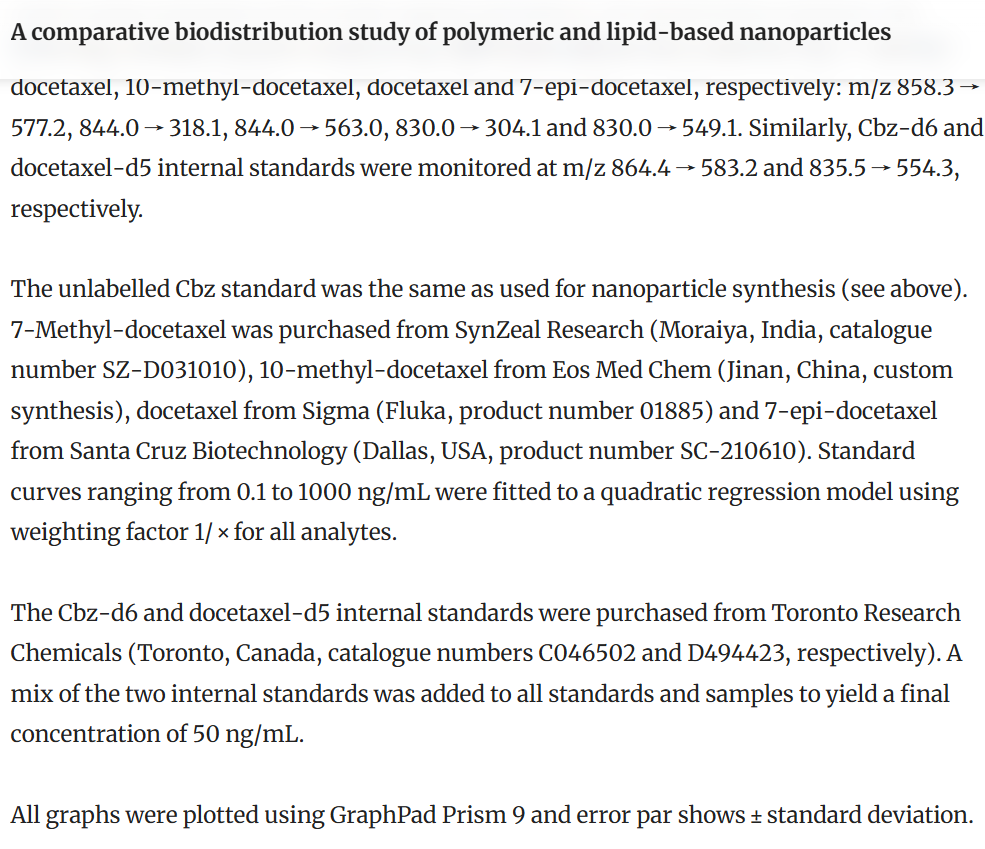
10-methyl-docetaxel (CAS 160084-81-1), manufactured by Eos Med Chem, was used in this study as a reference standard for the quantitative analysis of cabazitaxel (Cbz) metabolites. Specifically, the researchers utilized this substance to develop an LC–MS/MS (liquid chromatography-tandem mass spectrometry) assay for the identification and quantification of cabazitaxel metabolites in rat blood and tissue samples, thereby enabling an analysis of the drug’s metabolic pathway and tissue distribution in vivo.
Its specific utility is threefold:
1. Elucidation of the metabolic pathway: The study revealed that cabazitaxel first undergoes demethylation at the C7 position to form 10-methyl-docetaxel, which is subsequently demethylated at the C10 position to yield docetaxel. Thus, 10-methyl-docetaxel serves as a key intermediate in the in vivo metabolism of cabazitaxel.
2. LC–MS/MS quantitative analysis: The researchers employed 10-methyl-docetaxel—custom-synthesized by Eos Med Chem—as an analytical standard to construct a calibration curve. Its concentration in blood and various tissues was then measured via specific mass spectrometric ion transitions (m/z 844.0 → 563.0).
3. Investigation of metabolism and tissue distribution: By quantifying 10-methyl-docetaxel and its downstream metabolite, docetaxel, the researchers analyzed the metabolism of cabazitaxel across different organs. The findings indicated that metabolite concentrations were highest in the liver during the early stages, while a trend of persistent accumulation was observed in lung tissue.
For Eos Med Chem, the significance of this work lies in the provision of a custom-synthesized 10-methyl-docetaxel analytical standard, which facilitated the qualitative and quantitative study of cabazitaxel metabolites. This compound was neither the drug administered in the experiment nor a component of the nanocarrier system; rather, it served as a critical analytical reference for investigating the drug’s in vivo metabolism and tissue distribution.
Notably, the authors also suggested that the conversion of 10-methyl-docetaxel into docetaxel may represent the rate-limiting step in this metabolic pathway.
Full study: https://link.springer.com/article/10.1007/s13346-022-01157-y