
A recent study published in 《Cancer Science》—conducted by the team of Dr. Kobayashi at the National Cancer Institute (NCI), part of the U.S. National Institutes of Health (NIH)—investigated whether the intratumoral injection of antibody-photoabsorber conjugates (APCs) could enhance the efficacy of near-infrared photoimmunotherapy (NIR-PIT). The researchers conjugated antibodies targeting various tumor antigens (EGFR, CD29, EpCAM, and PDPN) with the photosensitizer IR700 (IRDye700DX) and compared the therapeutic outcomes of intratumoral injection (IT-PIT) versus conventional intravenous injection (IV-PIT) across several murine tumor models. The results demonstrated that intratumoral injection achieved higher concentrations and broader distribution of the APC within tumor tissue, while significantly reducing its accumulation in normal organs such as the liver and kidneys. Notably, even at substantially lower doses, the direct tumor-killing efficacy of the APC remained comparable to that achieved via intravenous administration. In immunocompetent mouse models, intratumoral delivery effectively activated CD8+ T cells, enhanced immune cell infiltration into the tumor, and prolonged survival—indicating that the approach exerts both a direct anti-tumor effect and the capacity to stimulate an anti-tumor immune response. Furthermore, intratumoral administration holds the potential to minimize off-target damage to healthy tissues and reduce systemic side effects, making it particularly well-suited for solid tumors accessible via direct needle puncture. The study suggests that the intratumoral injection of APCs represents a promising new delivery strategy for NIR-PIT; however, further research is required to determine optimal dosing, timing of administration, drug distribution within large human tumors, and overall clinical efficacy.
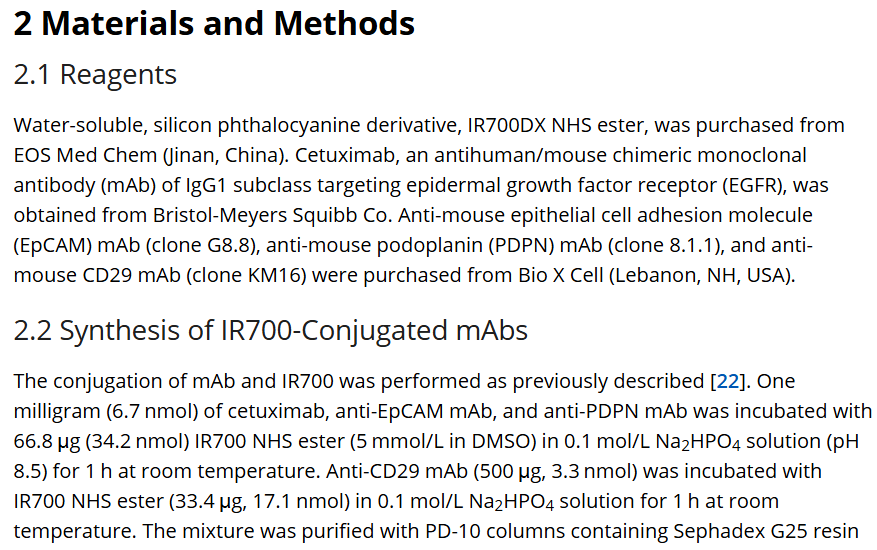
In this study, the IR700DX NHS ester—supplied by EOS Med Chem—served as the core photoabsorber for NIR-PIT, acting as the essential component that links tumor-targeting antibodies to the near-infrared light-mediated tumor-killing mechanism. Rather than acting as a direct anti-cancer drug, this agent is conjugated by researchers to various monoclonal antibodies to form antibody-photoabsorber conjugates (APCs), which are then used to target tumor cells and destroy them upon exposure to light.
By reacting IR700 NHS ester with different antibodies, the researchers developed four types of APCs:
| Antibody-IR700 Conjugate | Target Antigen |
| Cet-IR700 | EGFR |
| EpCAM-IR700 | EpCAM |
| PDPN-IR700 | Podoplanin |
| CD29-IR700 | CD29 |
The study determined that the average number of IR700 molecules conjugated to each antibody was 3, 4.8, 5, and 5, respectively. Subsequently, these APCs were tested in mouse tumor models to compare the therapeutic efficacy of intratumoral injection (IT-PIT) versus intravenous injection (IV-PIT).
Full study: https://onlinelibrary.wiley.com/doi/10.1111/cas.70518